
FAQs

Transit Recipients (expandable)

Monthly Requirement – UPT, VRH, VRM
DRPT requires that all recipients of MERIT – Operating Assistance funding,                       WMATA, and VRE report the following data on a monthly basis for all transit                       modes operated for three performance metrics:

  • Unlinked Passenger Trips (UPT) – Number of passengers who board public transportation vehicles, regardless of whether a passenger is transferring from another transit vehicle.
    • one boarding = one rider
  • Vehicle Revenue Hours (VRH) – Hours traveled by revenue vehicles (buses, vans, railcars, etc.) while in revenue service.
    • Note: For uni-directional commuter routes greater than 20 miles in length, non-revenue hours associated with deadhead trips will be considered as revenue vehicle hours for the purpose of allocating operating assistance.
  • Vehicle Revenue Miles (VRM) – The miles that vehicles actually travel while in revenue service.

Annual Requirement – Passenger Miles Travelled

Transit grantees that report Passenger Miles Travelled (PMT) to the National Transit Database (NTD) must also report annual PMT in DRPT’s Performance Data Reporting SharePoint.

  • Passenger Miles Travelled (PMT) – Cumulative sum of the distances traveled by each passenger as reported to the National Transit Database. This metric is used for calculation of the Commuter Rail Pool and is estimated for small transit agencies based on reported ridership relative to statewide average distance traveled by commuter rail and commuter bus agency passengers.

PMT data is due to DRPT on December 15th for the previously completed fiscal year (i.e. FY25 annual data is due on December 15, 2025).

TRIP Projects – Required Performance Metrics

I-66/I-95 Projects – Required Performance Metrics

Ridership on the grant funded portion of the route

Ridership on the entire route

  1. Identification of transit services provided during the quarter (by dates, times, route numbers and run/trip numbers).
  2. Total ridership for the previous quarter for all trips provided on the specified eligible routes.
  3. Monthly ridership totals for the previous quarter for all trips provided on the specified eligible routes.
  4. Daily ridership totals for the previous quarter for all trips provided on the specified eligible routes.
  5. Running month to month comparison of monthly ridership totals for all trips provided on the specified eligible routes.
  6. Monthly ridership totals for all trips provided on the specified eligible routes for the same months in the previous year (for year to year comparison).
  7. Passengers per revenue hour for the previous quarter for the specified eligible routes.

Passengers per revenue mile for the previous month for the specified eligible routes.

Commuter Assistance Program (CAP) Recipients (expandable)

DRPT requires all performance data to be reported through DRPT’s Performance Data Reporting Microsoft SharePoint site. If you need access to your agency folder on the SharePoint, please reach out to your Program Manager or DRPT’s performance data reporting point-of-contact.

Transit Recipients (expandable)

Transit recipients are required to submit UPT, VRH, and VRM in DRPT’s Performance     Data Reporting Microsoft SharePoint site on or before the last business day of each month for the previous month’s activity (ex: the deadline to submit July data is the last business day in August).

Commuter Assistance Program (CAP) Recipients (expandable)

Recipients of DRPT Commuter Assistance Program (CAP) funding are required to submit their Rideshare Inquiries into SharePoint monthly along with the supporting documentation.

Transit Recipients (expandable)

Yes! Grantees may amend previously submitted performance data in SharePoint if errors are discovered.

DRPT asks transit agencies to complete performance data amendments in SharePoint no later than December 31st for the previous fiscal year

  • ex: FY25 amendments are due by December 31, 2025.
  • In January, DRPT Transit Planners and Program Managers will conduct a check of all performance data submitted for FY25 to flag variances of 10% or greater
  • If a variance is identified, the grantee must describe the reason for the variance
  • Grantees will hear from their DRPT Program Managers in mid-January to verify FY25 data and describe any variances (if needed)

Commuter Assistance Program (CAP) Recipients (expandable)

Rideshare Inquiries data can be amended if errors are discovered. Reach out to   your Program Manager for more info.

Please reference the Accessing the Performance Data SharePoint document for guidance on authenticating through Microsoft – Accessing-the-Performance-Data-SharePoint.pdf.

If you’ve attempted to reauthenticate using the guidance above and you’re still unable to access your agency folder, please reach out to your Program Manager or DRPT’s performance data reporting point-of-contact to troubleshoot.

Yes! DRPT maintains a Transit Performance Data Dashboard on DRPT’s Open Data Portal. The dashboard contains statewide performance data

The dashboard is updated quarterly with the previous quarter’s activity (i.e. Q1 data is uploaded in October). You can interact with the data on the dashboard or download it.

Access the dashboard here: Transit Performance Data Dashboard – DRPT

No

Each year, as part of the MERIT (Making Efficient and Responsible Investments in Transit) grant program, DRPT allocates state operating assistance funding to transit agencies across the Commonwealth. The MERIT – Operating Assistance formula utilizes a performance-based methodology based on a combination of an agency’s sizing and performance factors including operating costs, ridership, vehicle revenue miles and hours. Sizing factors represent an agency’s relative size to other agencies across Virginia. Performance factors represent an agency’s performance trend for a given metric relative to statewide trends for all agencies.

Important Dates and Deadlines

January 31: Rural transit agencies submit NTD data for the previous fiscal year

December 1 – February 1: DRPT reviews previous fiscal year performance data as part of the annual Data Integrity check to ensure accurate data for the MERIT Operating Assistance formula

March: DRPT updates the operating formula with verified previous year’s performance data

April: Draft SYIP due to CTB (using operating formula results)

May/June: Rural NTD data Approved by NTD

June: SYIP approved by CTB

October/November: Rural NTD data from the prior fiscal year is published by NTD

Monthly: Rural transit agencies report monthly performance data to DRPT (SharePoint); CAP programs, including vanpool programs, are required to report their data monthly along with supporting documents.

Quarterly: PMs remind agencies of the monthly reporting requirement and ask that any performance data revisions are made in the SharePoint ASAP (quarterly meetings)

Definitions

Vehicle Revenue Hours:

  • Hours traveled by revenue vehicles (buses, vans, railcars, etc.) while in revenue service. For uni-directional commuter routes greater than 20 miles in length, non-revenue hours associated with deadhead trips will be considered as revenue vehicle hours for the purpose of allocating operating assistance.

  • The miles a vanpool is in revenue service from the first pick-up point to the final drop-off point.

Vehicle Revenue Miles:

  • The miles that vehicles actually travel while in revenue service.

Passenger Miles Travelled: only vanpool and urban agencies

Cumulative sum of the distances traveled by each passenger as reported to the National Transit Database. This metric is used for calculation of the Commuter Rail Pool and is estimated for small transit agencies based on reported ridership relative to statewide average distance traveled by commuter rail and commuter bus agency passengers.


Performance Data Reporting Modes

Transit Modes & Definitions:
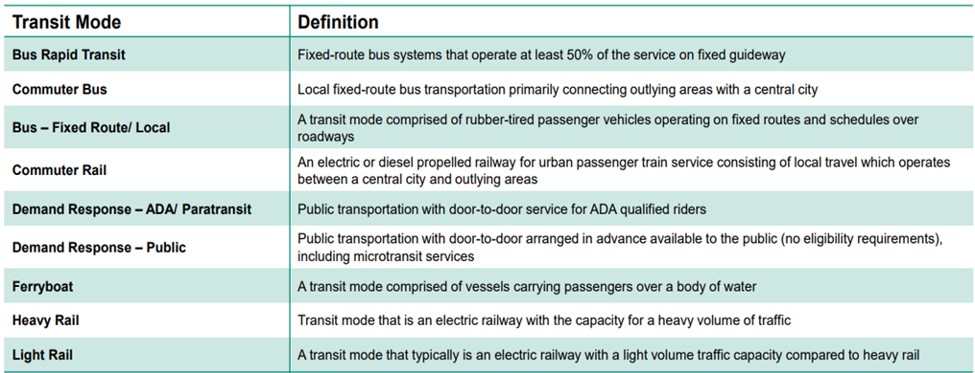
Table titled 'Transit Mode' and 'Definition.' Bus Rapid Transit: fixed-route bus systems that operate at least 50% of service on fixed guideway. Commuter Bus: local fixed-route bus transportation primarily connecting outlying areas with a central city. Bus – Fixed Route/Local: rubber-tired passenger vehicles operating on fixed routes and schedules over roadways. Commuter Rail: electric or diesel railway providing urban passenger service between a central city and outlying areas. Demand Response – ADA/Paratransit: public transportation with door-to-door service for ADA-qualified riders. Demand Response – Public: public door-to-door transportation arranged in advance and available to the public, including microtransit services. Ferryboat: vessels carrying passengers over a body of water. Heavy Rail: electric railway with capacity for a heavy volume of traffic. Light Rail: electric railway with a lighter traffic capacity than heavy rail.

CAP Modes & Definitions:

Table with columns labeled 'Service' and 'Definition.' Ridematching: online and mobile app ridematching service open to the public for finding carpool, vanpool, and transit matches for commuting or other travel purposes. Vanpool: vanpool service operators or NTD vanpool reporting programs. Employer Services: direct interaction with decision makers and employees at employer offices to establish transit and/or vanpool benefits and conduct onsite table events promoting carpooling, vanpooling, and transit.

RideShare Inquiries – number of carpool, vanpool and transit inquiries submitted during the specified period.

Vanpool Provider – A company that provides a commuter highway vehicle to the Vanpool Group through a vehicle lease or per seat cost.

Requirements for data reporting:

  • Data reported to DRPT must be consistent with any data reported to the National Transit Database (NTD). DRPT will check for inconsistencies when data is reported

CAP programs that report NTD data for vanpools must include their data from their Vanpool Provider that is reported to the National Transit Database. If more than one Vanpool Provider represents the data, all data for each of the Vanpool Providers must be reported to DRPT along with one combined total. DRPT will check for inconsistencies when data is reported.
