
FAQs
What is it?
The Transit Ridership Incentive Program (TRIP) provides funding to transit agencies and governing bodies for the purpose of creating more accessible, safe, and regionally significant transit networks.
What does it fund?
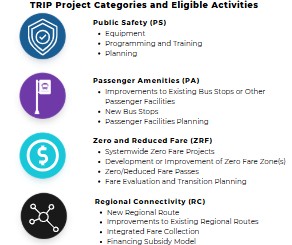
TRIP funds projects under four categories: regional connectivity, zero and reduced fare, public safety, passenger amenities and facilities. Projects under these projects can range from regional routes to bus shelters and other capital needs.
What is the match rate?
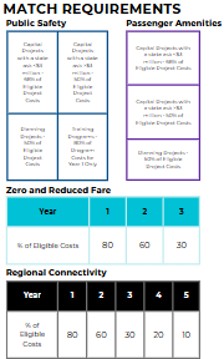
Regional Connectivity and Zero and Reduced Fare have stepdown match rates, public safety and passenger amenities both follow the same match rates as MERIT Capital (68% state). Planning projects follow the match rates of MERIT Technical Assistance (50% state).
Who is eligible?
Depending on the project category, MPOs, PDCs, current recipients of state operating funding, and local governments are eligible to apply for funding.
Background
TRIP is a state funding program to promote improved regional transit service in urbanized areas, reduce barriers to transit use for low-income individuals, and provide supplemental financial support for public safety and passenger amenities projects.
Process Outline
Applicable Parties
Transit agencies, MPOs, PDCs, local governments
Key Takeaways
- Multiyear grants under TRIP have stepdown match rates that require advanced planning both at the application phase and implementation phase. Require more preparation at the local level prior to applying.
- The timing for our grant application period is not always ideal, so you will have to anticipate needs ahead of what might be the case for other funding, such as by expanding your planning time horizons from six months to eighteen months.
- When it comes to what is considered regionally significant, definitions exist from multiple organizations which can create a lack of clarity, so be sure to reach out to staff at DRPT prior to applying if you would like to better understand what is regionally significant.
- Every project is unique, so if you do have concerns about eligibility, continued contact with DRPT staff is encouraged.
- Ensuring the applications are tailored to the specific project category and demonstrate sufficient project readiness is significant. DRPT having to request additional information after submission could lead to delays in approval of projects.
Key Actions
What are the calls to action/to-do items relevant to this topic?
- First ensure that you are set up as an actual eligible applicant/recipient in WebGrants.
- Verify your eligibility.
- Gather key details and requested information in the application.
- Apply under the appropriate funding opportunity.
- Consult the Blue Book for more specific guidance pertaining to each project category.
- Submit by the deadline, typically February 1st.
- Review the draft SYIP upon release in April to determine if your project was recommended for funding.
Key Strategies
Some successful projects under TRIP include…
- Reach out to agencies that were successfully awarded funding to learn more about what made their application and project competitive under this program.
- Being as clear as possible in your narrative answer so that it is easily understood what the funding is being requested for.
- Start early in developing your application, including when it comes to stakeholder outreach, and evidence of benefits and impacts from the project.
Key Information
- You would need to know what projects are eligible for funding under each of the project categories and determine if the project you propose would be eligible.
- You would need to know the match rates for each project category to know the amount of funding you would need to provide and ask for.
- You would need to know whether you as an organization are eligible to apply or if you would need to partner with another organization that is eligible.
Additional Information
- Certain project types are prioritized for funding under each project category based on the following criteria
- Impact on Ridership
- Impact on Accessibility
- Impact on Customer Service
- All projects are also assessed based on project readiness and scope
- If your MPO, PDC, or project falls within the boundary of the MSA below, you would be eligible for funding under TRIP Regional Connectivity:
(INSERT MAP HERE) - Reporting requirements for TRIP projects are outlined in the purple book (we hope).